Tulis
Oud Maniac

Posts: 57
Registered: 12-2-2018
Location: Greece
Member Is Offline
Mood: No Mood
|
|
Stringing Sukkar oud
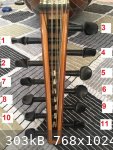
Hello, on Ibrahim Sukar's oud I have the strings placed as in the photo. However, I have seen some with a different string sequence. Does anyone have
a suggestion for something different?
|
|
|
Tulis
Oud Maniac
Posts: 57
Registered: 12-2-2018
Location: Greece
Member Is Offline
Mood: No Mood
|
|
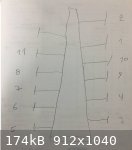
I received a reply from the manufacturer regarding the stringing.
I am sending you a diagram to help anyone who might need it.
|
|
|
coolsciguy
Oud Junkie
Posts: 268
Registered: 5-14-2020
Location: Washington D.C.
Member Is Offline
Mood: No Mood
|
|
I string mine like a guitar and never understood the logic behind the traditional way (like your oud). I suggest you try both and make a decision what
works for you.
-- Amir
|
|
|
Brian Prunka
Oud Junkie
Posts: 2987
Registered: 1-30-2004
Location: Brooklyn, NY
Member Is Offline
Mood: Stringish
|
|
Quote: Originally posted by Tulis  | I received a reply from the manufacturer regarding the stringing.
I am sending you a diagram to help anyone who might need it. |
This diagram is for F - f'f' tuning. Commonly the first two strings are strung to the furthest peg so that the rest of the strings are still in the
usual spots.
So this order is basically the same as your order with strings 10, 11, 12 omitted and extra strings added on the treble side.
The order you initially posted is the "classic" scheme as I learned it for C/D FF/GG AA dd gg c'c'
There is a "modern" order that some people use - it's what Simon Shaheen taught me, where the 12 are in the same place but 34 take the place of 78, 56
take the place of 34, and 78 take the place of 56. A bit more like a guitar (or violin).
They're all fine, but sometimes if you switch the order you might need to move the holes in the pegs to get the strings to go in straight lines.
|
|
|
maraoud108
Oud Maniac
Posts: 82
Registered: 2-3-2021
Member Is Offline
Mood: No Mood
|
|
I've always found string changing to be a nightmare, despite videos that I've watched.
I recently saw this video and it really really helped.
https://www.youtube.com/watch?v=wAZQ0oQIrpI&t=1804s
|
|
|
Tulis
Oud Maniac
Posts: 57
Registered: 12-2-2018
Location: Greece
Member Is Offline
Mood: No Mood
|
|
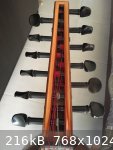
I installed the strings. The tuning is very easy and very precise. Before I had a lot of problems. I suggest you try it on ALL your tunings. It
doesn't matter what tuning you have. It solves all friction problems. It's a matter of space planning, geometry and mechanics. I'm sending you an
image to study it. Also pay attention to the details. See for example how the strings with their direction (their angle) push the keys down so that
they don't loosen. See the way they are wound on the key so that the coils are held tightly side by side in a row and don't thin out, creating a solid
and stable result.
|
|
|
MattOud
Oud Junkie
Posts: 306
Registered: 1-18-2017
Location: Ontario, Canada
Member Is Offline
Mood: Feeling Pretty G'Oud
|
|
Thanx for the helpful posts regarding stringing a Sukkar. It has been a while since i have put new strings on my Sukkar, to me it still sounds fine,
but when i do re-string, this will be helpful!
Cheers,
Matt
|
|
|
Brian Prunka
Oud Junkie
Posts: 2987
Registered: 1-30-2004
Location: Brooklyn, NY
Member Is Offline
Mood: Stringish
|
|
Hi Tulis,
It's admirable that you are experimenting to get better at stringing the oud. However, I must caution others that this example you posted above is
not one to emulate. You currently have a single data point with far too many variables to make any conclusions (if we are adopting a scientific
mindset regarding this experimentation).
You are correct that winding towards the peg is a good idea if possible in order to have the tension pushing the peg into the hole a bit, but it's
just one factor. However, it is generally more important to avoid string crossing as much as possible.
First, there is too much crossing in these strings. Particularly what looks like the F strings crossing the A string will usually cause problems,
including buzzing.
Second, the string order you used is for high F-f' tuning but it looks like you are using C-c' tuning, which is peculiar. There is no advantage to
this. It's not terrible but adds unnecessary confusion.
Third, regardless of the scheme used, you should cut the strings to the appropriate length before winding them, there is way too much excess length on
many of these strings (1,2,4,7,8,9,10). This much excess length causes friction and pressure against the sides of the pegbox, making tuning less
smooth, especially over time.
If the nut is smooth and well-made, the pegs are well-made and fit properly, and the strings are carefully installed according to the standard
methods, tuning is perfectly stable and smooth.
By all means continue to experiment! And I'm glad that your careful stringing has improved your experience. But it's a bit early yet to propose a new
model for stringing 
|
|
|
Tulis
Oud Maniac
Posts: 57
Registered: 12-2-2018
Location: Greece
Member Is Offline
Mood: No Mood
|
|
| Quote: Originally posted by Brian Prunka | Hi Tulis,
First, there is too much crossing in these strings. Particularly what looks like the F strings crossing the A string will usually cause problems,
including buzzing. |
These crossings have a contact point of at most one tenth of a millimeter — the strings do not touch along their length. The result of this is that
they stop buzzing, not cause it.
| Quote: Originally posted by Brian Prunka | Hi Tulis,
Second, the string order you used is for high F-f' tuning but it looks like you are using C-c' tuning, which is peculiar. There is no advantage to
this. It's not terrible but adds unnecessary confusion. |
Previously you wrote: "I must caution others that this example you posted above is not one to emulate" — and now you're saying that it's actually
used for high F-f' tuning? So which is it? Is it a setup that shouldn't be emulated?
| Quote: Originally posted by Brian Prunka | Hi Tulis,
Third, regardless of the scheme used, you should cut the strings to the appropriate length before winding them, there is way too much excess length on
many of these strings (1,2,4,7,8,9,10). |
They are already cut to the length I wanted. How exactly did you measure the length of the strings, knowing of course their original length as well,
in order to determine that I didn't cut them?
| Quote: Originally posted by Brian Prunka | Hi Tulis,
This much excess length causes friction and pressure against the sides of the pegbox, making tuning less smooth, especially over time.
|
Please explain this a little more — with that 'scientific mindset' you mentioned earlier. How exactly does the number of windings add pressures that
act drastically? And how does each free winding create forces that interfere with the tensions of the wood?
Early in relation to what? Did you measure the time I dedicated to this? Did I propose a new model of stringing? You said yourself earlier that it's
used for F tuning. I also mentioned that I saw it from Sukkar — it's not mine.
Let's get serious. I'm suggesting — not imposing — that anyone who wants to, should try this method. For me, having applied it, it solved several
problems and I saw the benefits in practice. That's all I wanted to share. I wasn't trying to take anyone's crown.
|
|
|
Brian Prunka
Oud Junkie
Posts: 2987
Registered: 1-30-2004
Location: Brooklyn, NY
Member Is Offline
Mood: Stringish
|
|
You are strongly encouraging others to follow your example, and claiming causal certainty, so it is reasonable to warn others that this example has
issues and your certainty does not appear to be well-founded. There is no "crown" to be had here.
I am simply sharing my own observations that come from my own experience, which comes from having played oud for over 28 years, experimenting a great
deal myself, stringing ouds more times than I can count, replacing and modifying pegs and nuts, and learning from watching luthiers like Najib Shaheen
as well as observing the stringing setups of many, many professional players in order to learn and improve.
Indeed anyone is welcome to try anything.
I'm just adding information that people can additionally evaluate when considering how to string their instrument. I get that you were trying to be
helpful—so am I.
Stringing ouds is annoying and tricky enough, we are all on the same team here. I don't say this to claim any sort of crown, there is no king of oud
(except Farid  )
It's great that you are happy with your current setup. I'm not trying to attack you or convice you to change. I don't wish to argue! If you are
really sincere in wishing to explore the topic, I will attempt to clarify and explain below.
| Quote: Originally posted by Tulis |
These crossings have a contact point of at most one tenth of a millimeter — the strings do not touch along their length. The result of this is that
they stop buzzing, not cause it.
|
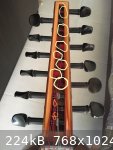
I will share an image here, the orange circles indicate spots where they are crossing.
Buzzing is caused when the distance between strings is close enough that vibrations can cause sympathetic resonance, or when crossings result in free
string lengths that match an overtone of a played note. They don't even actually have to touch, just be very close so that vibrations in the air cause
sympathetic vibrations. If you have no buzzing here, that's good, but it is due to luck and not evidence of a good system. Careful avoidance of this
reduces the likelihood of buzzing.
| Quote: Originally posted by Tulis |
Previously you wrote: "I must caution others that this example you posted above is not one to emulate" — and now you're saying that it's actually
used for high F-f' tuning? So which is it? Is it a setup that shouldn't be emulated?
|
There's no contradiction here. This general arrangement is fine and can be useful for high f' tuning since it keeps the other pitches in the "usual"
spots. What is wouldn't recommed emulating is the specific issues in the string crossings and windings, or (as you seem to be doing) using this
scheme on a high c' tuning.
| Quote: Originally posted by Tulis |
They are already cut to the length I wanted. How exactly did you measure the length of the strings, knowing of course their original length as well,
in order to determine that I didn't cut them?
|
I can see clearly in the photo (circled in yellow) that the strings have too many windings and so have not been cut to a proper length. It doesn't
matter what the original length was.
| Quote: Originally posted by Tulis |
Please explain this a little more — with that 'scientific mindset' you mentioned earlier. How exactly does the number of windings add pressures that
act drastically? And how does each free winding create forces that interfere with the tensions of the wood?
|
Windings are not an issue until you have too many to fit easily and they begin touching the pegbox, as is happening or is very close to happening (and
will likely happen over time with retuning) in your example image.
When you have so many windings that the string touches the side of the pegbox, this limits the movement of peg, pushing it farther into the small hole
on the other side rather than allowing the optimal pressure you choose (i.e., the string winding is pushing the peg rather than the person tuning it).
You can easily confirm this by doing the reverse side of the peg with too many windings - it will push the peg out of the hole. The pressure and
friction of the peg works best when you as the player can control it; anything that reduces that control is detrimental.
This is not a controversial view.
There are many variables here:
1) assignment of strings to pegs (there are 11 assignments here, so really quite a lot of possibilities if one really wanted to explore them all, but
at a minimum, the "standard" assignments are a few important possibilities)
2) position of the hole through which each peg is inserted (this interacts with point 1 in ways that can cause string crossings at a minimum, as well
as affecting the angle of the string at the nut, which can cause friction issues). It's not unncommon to drill new holes to improve the distribution
of the strings.
3) number of windings on the peg (this also interacts with 1&2 to affect the angle of the string and crossing, as well as potential pressure on
the peg/pegbox)
4) the direction of windings on the peg (this becomes more important the more windings there are)
5) how well-cut and smooth the nut is. Nut material, the depth of the slots, the shape of the slots (particularly the edges) will affect tuning and
stability
6) the strings used
What I mean by being scientific is that in order to come to more definitive answers, one must isolate these variables and test them independently as
much as possible. So test a stringing pattern with different brands of string, on different ouds, with more/fewer windings, with and without string
crossing, etc.
One can also learn from the experimentation others have done, though it is totally great to retest for yourself - sometimes the accepted wisdom is
indeed wrong!
In this case, here is my evaluation of your experiment:
a) I don't follow your arrangement of strings on any of my ouds, but my strings are easy to tune and perfectly stable with no issues whatsoever (on
several different ouds), plus I have used different arrangements and found zero effect on the tuning (just slight differences in perceived tension on
certain strings). I have specifically tested this on more than one Sukar oud specifically.
So this is clear evidence that whatever benefits you have found are not specifically due to using this arrangement: others not following this example
exhibit none of the problems it is purported to solve.
b) I have found specifically and repeatedly that string crossings can cause buzzing and eliminating string crossings generally stops buzzing, and have
confirmed similar findings amongst many other professional oud players. So even if you are fine this time, it seems most likely that you have been
lucky, and not that string crossing is fine and recommended. It may also turn out that while it doesn't buzz right now, the slight variations caused
as you retune it over time may cause buzzing in the future. At best, this is a rather speculative benefit.
c) I have found via experience and also confirmed with luthiers that excessive string windings can cause undesirable pressure on the pegbox and
reduces control over the tuning. Again, this is often okay at first but as you retune over time (especially with changing seasons affecting the
strings and wood) the problem can surface. This is so robustly confirmed that there can be no mistake.
d) you have also changed the brand/type of strings you are using, which is a highly confounding variable for any conclusions you wish to draw.
e) it seems that for now your nut is okay if you are indeed having no issues at this time, so that's good. But that just indicates it's not a
significant variable in this case. For others it often is (I'd estimate that, absent user error, about 30-40% of tuning issues are due to badly cut
nuts, and another 50% to badly made pegs), and no amount of switching strings around is likely to help.
| Quote: Originally posted by Tulis |
Early in relation to what? Did you measure the time I dedicated to this? Did I propose a new model of stringing? You said yourself earlier that it's
used for F tuning. I also mentioned that I saw it from Sukkar — it's not mine.
|
Apologies if that wasn't clear - I meant that people have been stringing ouds for over a thousand years, and there is quite a bit of aggregated
knowledge and experience that have gone into the many conventions and standards. So excess winding and string crossing have a well-studied history
of problems.
In addition, standards are useful for other reasons, even when they may be arbitrary. For instance, I know if I pick up an oud, it will 95% of the
time be strung according to one of the main systems, so I can easily and quickly adapt to tuning it. Ultimately, using the F-f' system on a C-c' oud
is not really a "problem" but it is a bit impractical for most people in the long run since everyone else agrees. Even the existence of this scheme
is confirmation of this, the reason they did this is that so players used to high c' tuning still have the pegs in the "usual" spot for those strigs
and only the "extra" high f' peg positions need to be considered.
|
|
|
Tulis
Oud Maniac
Posts: 57
Registered: 12-2-2018
Location: Greece
Member Is Offline
Mood: No Mood
|
|
The real result is that it eliminates buzzing. It tunes easily without the pegs slipping. Practice has shown this. I disagree with you on all the
technical points, but it doesn't matter. What matters is to hear the opinion of those who try this stringing and gain real experience. It will be very
interesting to hear their view.
|
|
|
|